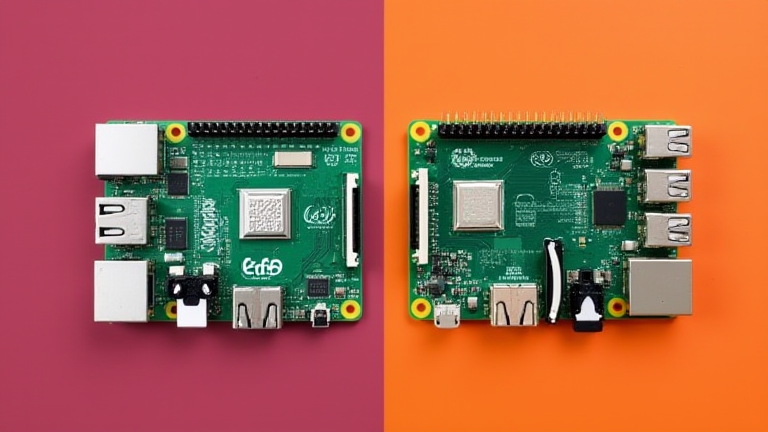
Raspberry Pi 5 vs. Orange Pi 5: Which Single-Board PC Wins for AI
TL;DR: The Orange Pi 5 generally offers superior raw computational throughput for AI workloads due to its higher memory bandwidth and more robust NPU capabilities. However, the Raspberry Pi 5 retains the edge in ecosystem maturity, software support, and ease of deployment for most developers.
The single-board computer (SBC) landscape has become fiercely competitive, with the Raspberry Pi 5 and Orange Pi 5 emerging as top contenders for edge AI applications. While both boards represent a significant leap forward in performance compared to their predecessors, they cater to slightly different needs within the artificial intelligence domain. Understanding the nuances between these two platforms is crucial for engineers and hobbyists alike who are building intelligent systems.
If you want to dig deeper, check out our guide on Top L-Arginine-Rich Foods: Boost Your Levels Naturally.
Hardware Specifications and Performance
The Raspberry Pi 5 features a quad-core Arm Cortex-A76 processor running at 2.4 GHz, paired with up to 8 GB of LPDDR4X-4267 RAM. Its inclusion of a dedicated AI accelerator, the Hailo-8L, provides up to 13 TOPS of inference performance, making it remarkably efficient for tasks like object detection and image classification. In contrast, the Orange Pi 5 utilizes a Rockchip RK3588S chip, which also offers up to 6 TOPS of NPU performance but benefits from a more powerful general-purpose CPU cluster. The Orange Pi 5 often outperforms the Pi 5 in multi-core CPU tasks and memory bandwidth, which can be critical for loading large language models or processing complex video streams in real-time.
Software Ecosystem and Development Experience
One of the Raspberry Pi’s enduring strengths is its unparalleled software support. The official Raspberry Pi OS is optimized for the hardware, ensuring stability and seamless integration with Python libraries such as TensorFlow Lite and PyTorch. The community support is vast, meaning developers rarely encounter insurmountable technical hurdles. The Orange Pi 5, while supported by a growing community, still relies more heavily on custom-built Linux images. While the Rockchip BSP (Board Support Package) is improving, users may face occasional driver issues or require manual configuration for specific peripherals. For AI developers, this means the Pi 5 offers a “plug-and-play” experience, whereas the Orange Pi 5 requires a slightly steeper learning curve but offers higher performance ceilings.
Industry Impact and Future Outlook
Both boards are driving the democratization of edge AI. The Raspberry Pi 5 is widely adopted in educational settings and industrial prototypes due to its reliability and extensive documentation. The Orange Pi 5 is gaining traction in cost-sensitive high-performance applications where raw compute power is prioritized over ecosystem convenience. As AI models become smaller and more efficient, the gap between these two platforms may narrow. However, for immediate deployment, the Raspberry Pi 5 remains the safer choice for most projects, while the Orange Pi 5 appeals to power users seeking maximum hardware capability without a significant cost increase.
FAQ
Q: Which board has better NPU performance?
A: The Raspberry Pi 5’s Hailo-8L offers 13 TOPS, which is higher than the Orange Pi 5’s RK3588S NPU at 6 TOPS, making it more efficient for dedicated AI inference.
Q: Is the Orange Pi 5 easier to set up for AI development?
A: No, the Raspberry Pi 5 is generally easier due to its mature official OS and extensive community support, while the Orange Pi 5 may require more manual configuration for optimal performance.
Q: Can both boards run large language models locally?
A: Both can run quantized versions of small to medium-sized LLMs, but the Orange Pi 5’s higher memory bandwidth often allows for faster token generation in CPU-based inference scenarios.
Leave a Reply