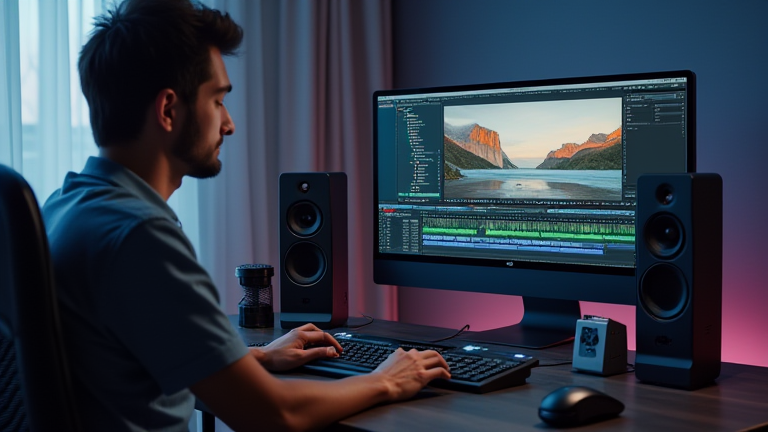
TL;DR: The Apple M4 Pro outperforms the Intel i9 in video editing due to its superior unified memory architecture and dedicated media engines that drastically reduce latency. This results in smoother 8K playback and significantly faster export times for professional workflows.
The Architecture Advantage
The latest developments in silicon design have fundamentally shifted the competitive landscape for creative professionals. The Apple M4 Pro chip introduces a refined unified memory system that allows the CPU, GPU, and Neural Engine to share data without the bottlenecks inherent in traditional discrete memory architectures. In contrast, even the most advanced Intel i9 processors rely on a discrete GPU setup, which often creates a bandwidth bottleneck when handling massive video files. This architectural difference means that the M4 Pro can feed data to the rendering engines much faster, allowing for real-time manipulation of high-resolution timelines. For editors working with 8K ProRes RAW footage, this translates into a fluid user experience where scrubbing through complex multi-layered sequences does not cause dropped frames or lag. The efficiency of this shared memory pool is a critical factor in why modern Macs have become the standard for high-end post-production suites, offering a level of responsiveness that discrete CPU-GPU configurations struggle to match consistently.
If you want to dig deeper, check out our guide on Best Wireless Earbuds for Gym: 10 Top Picks.
Media Engines and AI Acceleration
Specs alone do not tell the whole story; the inclusion of dedicated media engines in the M4 Pro is a game-changer for video workflows. These hardware-accelerated processors handle video encoding and decoding tasks directly, offloading the burden from the main CPU cores. This means that while the M4 Pro is rendering a complex timeline, the system remains responsive to other tasks, such as color grading or audio mixing. Intel’s i9 chips, while powerful in raw multicore performance, lack this specific hardware optimization for video codecs. Furthermore, the M4 Pro’s Neural Engine is optimized for AI-driven editing tools, such as background removal and auto-stabilization. These features, increasingly integrated into major editing software like DaVinci Resolve and Adobe Premiere Pro, run significantly faster on Apple silicon. The result is a workflow where AI-assisted tasks that might take minutes on an Intel system are completed in seconds, allowing editors to spend more time on creative decisions rather than waiting for processing power.
Industry Impact and Future Trends
The industry impact of this performance gap is already visible in studio environments worldwide. Many major film and television production houses are transitioning their entire editing pipeline to Apple Silicon-based workstations, citing improved energy efficiency and reduced cooling requirements as key benefits. The M4 Pro’s ability to deliver desktop-class performance in a compact form factor without a discrete GPU has also influenced the design of portable editing stations, making high-end post-production more accessible for on-location work. As video formats continue to evolve toward higher resolutions and frame rates, the limitations of traditional CPU-GPU architectures become increasingly apparent. The success of the M4 Pro signals a broader trend where specialized hardware accelerators and unified memory architectures are becoming essential for professional creative tools. For Intel to remain competitive in this niche, they must innovate beyond raw clock speeds and focus on integrating similar media-specific optimizations into their next-generation processor designs.
FAQ
Q: Does the M4 Pro handle 8K video better than the i9?
A: Yes, the M4 Pro’s dedicated media engines allow for smoother real-time 8K playback and faster exports compared to the i9.
Q: Is the M4 Pro more energy efficient than the i9?
A: Absolutely, the M4 Pro delivers similar or better performance while consuming significantly less power and generating less heat.
Q: Can I use existing Intel software on the M4 Pro?
A: Most modern creative applications have been optimized for Apple Silicon, ensuring full compatibility and native performance benefits.
Leave a Reply