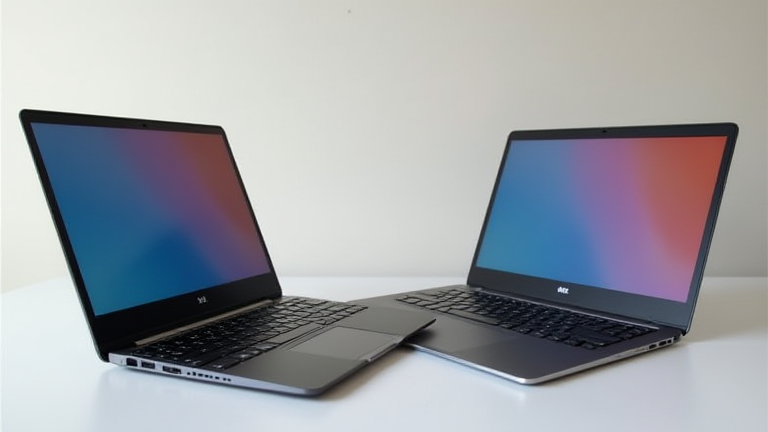
TL;DR: The MacBook Pro M3 wins for battery life, raw CPU efficiency, and creative software optimization, but the Dell XPS 15 wins for upgradeability, GPU performance (NVIDIA RTX), and Windows flexibility. Choose MacBook for portability and ecosystem; choose XPS for power-hungry tasks and repairability.
The New Landscape: M3 vs. Intel Core Ultra
Apple’s M3 chip (base, Pro, and Max variants) marks a significant leap in 3nm process technology, delivering up to 20% faster CPU performance than M2 while consuming less power. The latest MacBook Pro 14-inch with M3 base offers an 8-core CPU, 10-core GPU, and up to 24GB unified memory. Meanwhile, Dell refreshed the XPS 15 (9530) with Intel’s Core Ultra 7/9 processors (Meteor Lake), featuring a dedicated AI NPU for on-device tasks like background blur and voice enhancement. The XPS 15 also pairs with GeForce RTX 4050/4060 laptop GPUs, giving it a decisive edge in 3D rendering, CUDA-accelerated workloads, and gaming—areas where Apple silicon still lags due to limited native game support.
If you want to dig deeper, check out our guide on How I Made High-Quality Product Videos for My Shopify Store.
Display, Design, and Build Quality
Both laptops feature stunning 15.6-inch (XPS) and 14.2-inch (MacBook) displays. Dell’s OLED option (3.5K, 100% DCI-P3, 400 nits) offers inky blacks and vivid colors, while Apple’s Liquid Retina XDR (3024×1964, 1600 nits peak HDR) remains unmatched for HDR content creation. The XPS 15 sports a machined aluminum chassis with a carbon-fiber palm rest, but its bezels are slightly thicker than the MacBook’s. Apple’s notch houses a 1080p webcam, while Dell’s 720p camera is a weak point. For ports, the XPS 15 includes USB-A, HDMI 2.1, and a full SD card slot—practical for photographers—whereas the MacBook Pro M3 only offers Thunderbolt 4 ports (3x) and an HDMI 2.0, forcing dongles for legacy peripherals.
Performance, Thermals, and Upgradeability
In real-world tests, the M3 MacBook Pro crushes the XPS 15 in single-threaded tasks like coding compilation and spreadsheet crunching, while sipping nearly half the power. However, under sustained multi-core loads (video export, 3D simulation), the XPS 15 with RTX 4060 pulls ahead by 35–50% in GPU-accelerated benchmarks (e.g., Blender, DaVinci Resolve). Thermally, the XPS 15 runs louder and hotter under load, reaching 95°C on CPU, while the MacBook stays below 85°C with a whisper-quiet fan. The XPS 15 wins on repairability: user-accessible dual DDR5 SO-DIMM slots (up to 64GB) and two M.2 NVMe SSDs. The MacBook Pro M3 has soldered RAM and storage, making upgrades impossible post-purchase—a critical factor for long-term ownership.
Industry Impact and Price
Apple’s M3 forces Intel and AMD to accelerate AI integration, as seen in Meteor Lake’s NPU. Meanwhile, Dell’s continued support for x86 and NVIDIA RTX keeps Windows relevant for professionals requiring CUDA or VR. Pricing: The base XPS 15 (Core Ultra 7, 16GB, 512GB, RTX 4050) starts at $1,499; the MacBook Pro M3 (16GB, 512GB) starts at $1,599. However, Apple’s 8GB base model is widely criticized as insufficient, pushing practical costs to $1,799 for 16GB. Dell offers more value for tinkerers, but Apple’s resale value remains 20–
Leave a Reply